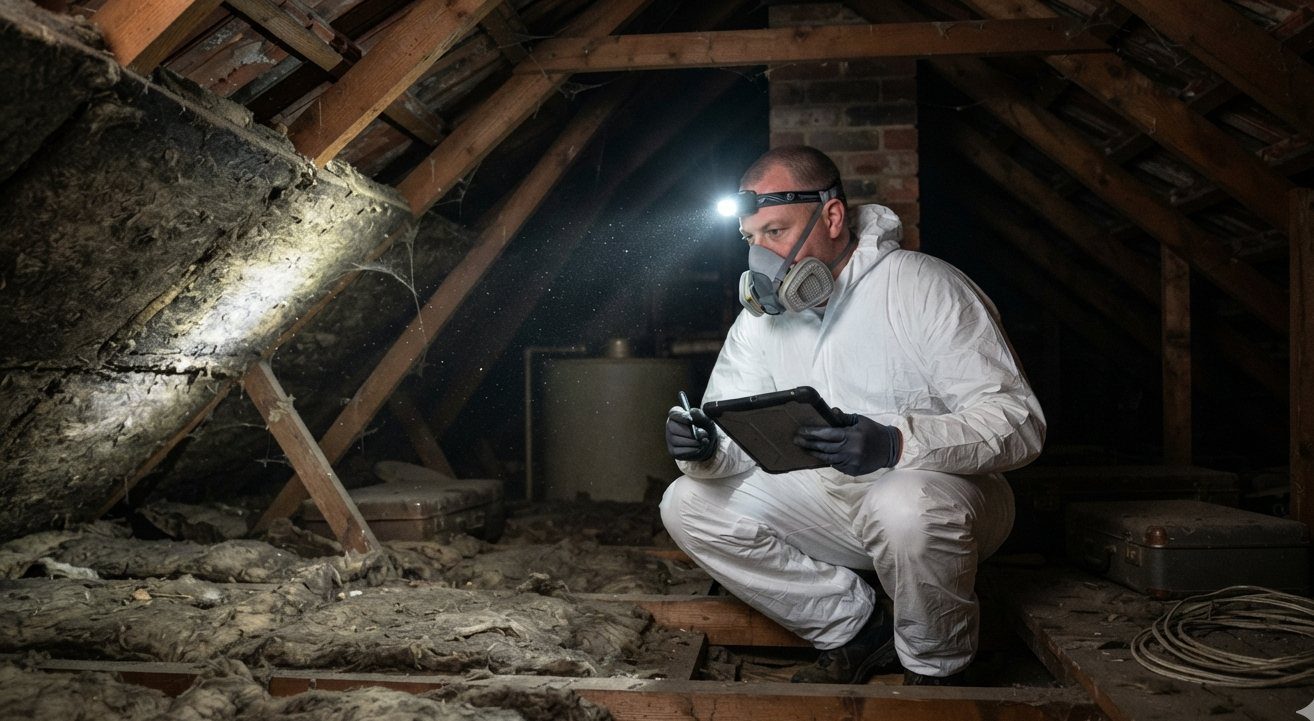

Where asbestos turns up in offices
In office buildings of the 1960s to 1980s the typical items are ceiling tiles and suspended ceiling boards, insulating board to riser doors, ducts and partitions, sprayed or boarded fire protection to steel beams and columns, vinyl floor tiles and their bitumen adhesive, pipe lagging and boiler plant, window panel infills, and textured coatings. Later refurbishments sometimes covered older materials with new finishes rather than removing them, so a modern-looking interior does not mean there is nothing behind it.
In converted period buildings, such as Victorian or Edwardian offices that have been refitted in stages, asbestos might be in later alterations and services rather than the original structure.

City-centre offices in Manchester and Preston, business parks and suburban offices often combine older structures with several generations of fit-out above the ceiling.
Occupiers and the duty to manage
If you occupy or manage an office building, the duty to manage under the Control of Asbestos Regulations 2012 applies to whoever has maintenance responsibility. In multi-let buildings this often means the landlord for the structure and common parts, and the tenant for the demised space if the lease says so. Check what your lease provides and ask the landlord for their register, because the existing register should already cover the common parts.
If there is no register, a management survey will provide one. The facilities team can then check it before contractors do any work, which is the most effective way to prevent accidental disturbance.
Before a fit-out, strip-out or cabling job
Office fit-outs are where asbestos is most commonly disturbed by accident. Above suspended ceilings, behind walls and below raised floors are exactly where data cabling, lighting and air conditioning are installed. Before any such work in a pre-2000 office, the area affected needs a refurbishment and demolition survey, which is intrusive and may disturb finishes. It is normally done while the floor is empty or at a quiet time.
Contractors are legally required to consider asbestos before work starts, and landlords commonly require a survey as a condition of licence for alterations. Booking it early removes a possible critical-path delay from the programme.
Lease events and due diligence
Dilapidations negotiations, lease assignments, purchases and lender due diligence all commonly ask for an asbestos register. If one is requested at short notice, get in touch and explain the timescale. We pass your request to an independent partner surveyor, who will contact you to agree scope and timing.